PPM tools for pharmaceutical compliance support teams carrying a heavy responsibility. Every clinical trial, every stage of drug development, and every interaction with regulatory authorities is ultimately about protecting patients.
Many pharmaceutical companies aren’t struggling with the science; they’re struggling with the pressure around it. The constant changes in regulatory requirements, the need to maintain perfect data integrity, and the reality that one missed detail could disrupt drug safety all place enormous strain on teams.
Project managers often feel this most.
This article explores how leveraging ppm tools for pharmaceutical compliance can bring more clarity, support, and calm into that environment — helping you stay organised, stay aligned, and stay focused on delivering safe, effective medicinal products to the patients who depend on them.

Working in the pharmaceutical industry comes with a kind of pressure that’s hard to describe unless you’ve lived it.
Every piece of clinical trial data, every adjustment to a protocol, every document sent to regulatory authorities carries weight. And behind all of that work are people who care deeply about getting things right for patients.
The challenge isn’t a lack of expertise; it’s everything that surrounds it. Regulatory requirements shift, teams stretch across time zones, and projects often overlap in ways that make even simple tasks surprisingly complicated.
A single delay in drug development, a missing attachment in a regulatory submission, or a question from the MHRA or the European Medicines Agency can throw an entire timeline off-course. It’s no wonder project managers can feel like they’re carrying ten calendars at once.
What most teams need isn’t more pressure — it’s space. A clearer view of what’s happening, fewer surprises, and a way to keep moving even when things change suddenly. That’s where PPM tools come into the picture. They don’t replace judgment or experience; they simply give people a better foundation to work from.
When you can see dependencies clearly, track actions without digging through email threads, and stay aligned with pharmaceutical regulations, everything becomes simpler.
Most pharmaceutical companies share the same goal: deliver safe medicinal products, avoid non compliance, and maintain trust with regulators and patients. But the work behind that goal is demanding.
With the right systems in place — ones that support coordination rather than complicate — teams are better equipped to focus on science, quality, and the decisions that really matter.

Discover practical strategies for improving oversight and audit readiness.
Working in the world of pharmaceuticals today often means navigating a shifting landscape of rules, expectations, and growing scientific ambition. In the US in 2024 alone, the Food and Drug Administration (FDA) approved 50 novel therapeutics — a clear signal that innovation continues to surge even under tight regulatory scrutiny.
At the same time, the European Medicines Agency (EMA) — together with national competent authorities in EU member states — is pressing ahead with rigorous inspection and approval regimes.
In 2024 the EMA and related agencies carried out 210 GMP inspections under centralised authorisation procedures alone. These inspections are part of a broader pattern of oversight that applies to sites, suppliers, manufacturing operations, and quality systems across global supply chains.
Why does this matter for teams building new medicinal products? Because regulatory submissions, compliance audits, quality-management, and manufacturing oversight all converge.
A single drug or biologic may pass through preclinical development, clinical trials, manufacturing qualification, regulatory filing and post-approval change control. Each step must meet strict standards of data integrity, traceability, and documentation.
If anything slips the consequences can be serious: delays, rejection, or even supply disruption.
For many pharmaceutical companies and life science organisations, that means they are juggling dozens — sometimes hundreds — of simultaneous projects.
Clinical trials in oncology or rare diseases, post-approval changes for manufacturing, validation of new facilities, labelling updates, or global packaging launches — all while trying to track dependencies, audit history, and regulatory deadlines.
Each project feels distinct. Yet behind them all lies the same unifying demand: deliver quality, compliance, and safety without sacrificing speed or innovation.
In this environment, teams need more than good intentions. They need structure, oversight, clarity, and systems that can handle complexity without drowning people in spreadsheets or email chains.
This is where PPM tools prove themselves as an essential part of modern pharma operations.
In regulatory projects, scope is often the quiet source of tension.
In the pharmaceutical industry, scope isn’t just an outline of tasks — it defines what gets submitted to regulatory authorities, what needs validating, and what auditors will eventually expect to see.
When scope isn’t clear or shared, teams feel it quickly: timelines slip, documentation becomes inconsistent, and the project becomes harder to defend during inspections.
Regulatory work brings together people from regulatory affairs, quality, clinical operations, IT, manufacturing, and external partners. Each group sees the project through a slightly different lens, shaped by their own responsibilities and priorities.
Without a shared system to align these perspectives, it’s easy for deliverables to multiply or diverge — a late gap analysis here, an unexpected validation activity there — and suddenly the project is heavier than anyone intended.
For pharmaceutical compliance, PPM tools make a meaningful difference.
Instead of relying on static documents or scattered conversations, a PPM platform creates a single source of truth for scope:
This structure doesn’t just reduce risk — it creates breathing room. When teams can see what’s included, what’s out of scope, and why decisions were made, they spend less time firefighting and more time delivering work that stands up to scrutiny.
PPM tools also help shift scope from a static document to something more dynamic and realistic.
As new information emerges — updated guidance, unexpected lab results, supplier delays — teams can adjust scope with transparency rather than scrambling behind the scenes.
Regulators appreciate this maturity too; it demonstrates control, traceability, and thoughtful decision-making.
In the end, strong scope management is one of the quiet enablers of compliance. With the right PPM framework behind it, scope becomes less of a risk and more of a guide — helping teams stay aligned, avoid unnecessary work, and build medicinal products in a way that feels organised, defensible, and fair to the people doing the work.

Learn how strong governance and planning translate into real results
Risk management is one of those areas that everyone understands is important, but few people enjoy dealing with. It’s detailed, it’s methodical, and it often forces teams to confront uncomfortable “what ifs.” Yet both the MHRA, FDA and the European Medicines Agency expect organisations to handle risks in a structured and transparent way.
ICH Q9 sets the tone: identify risks early, assess them honestly, and keep those assessments alive throughout the drug development and commercial lifecycle. During inspections, regulators pay close attention not just to the risks, but to how thoughtfully teams engaged with them.
The reality is that most risks in MHRA/FDA/EMA projects feel familiar. They show up as data integrity concerns, limited SME availability, supplier issues, incomplete requirements, or dependencies that no one spotted early enough.
Sometimes the risks are operational, sometimes they affect timelines, and sometimes they raise flags around drug safety. None of this reflects a lack of care from teams — it’s simply the nature of working in a complex, high-stakes environment. Regulators know this too, which is why they look for evidence of thoughtful review rather than perfection.
A good risk register helps bring order to that complexity.
It gives teams a single place to capture concerns, assign ownership, and agree on how to respond. At its best, a register feels like a shared safety net — something everyone can rely on when projects get busy or when unexpected issues appear.
Strong registers also connect risks to specific deliverables or medicinal products, making it easier to explain decisions during audits or inspections. That clarity can save hours of stress later.
Where teams often get stuck is keeping the register up to date. In a fast-moving project, risks evolve quickly.
A spreadsheet updated once a month can’t keep pace with shifting priorities, new findings, or last-minute changes to regulatory submissions.
This is where PPM tools for pharmaceutical compliance genuinely help. They give teams one environment to log risks, update them, and connect them to timelines, documents, and milestones without losing track of what changed along the way.
PPM tools also make the review process feel less like a formality and more like a conversation. When risks are linked to real schedules and real people’s workloads, it becomes obvious where attention is needed. Patterns emerge too — recurring bottlenecks in validation, repeated issues tied to resource allocation, or gaps in documentation.
These insights allow pharma organisations to strengthen processes rather than firefight the same issues repeatedly.
For global teams, especially those working across EU member states, a centralised risk view is invaluable.
When a manufacturing deviation, safety signal, or data issue arises, having everyone work from the same information helps teams respond faster and more consistently to regulatory changes. And when inspectors ask how decisions were made, teams have a clear, reliable story to tell.
At its core, risk management is about staying steady in an environment where uncertainty is normal. A thoughtful, well-maintained risk register — supported by the right PPM framework — gives teams exactly that: a steadier path through complex, high-stakes work.

Learn more about selecting the right project portfolio management tool for your organisation
When people talk about PPM tools for pharmaceutical compliance, the conversation often starts with features — dashboards, reports, task lists. But for the people doing the work, the real value feels much simpler: these tools make the day feel a little more manageable.
They help teams understand what’s going on without digging through emails, piecing together spreadsheets, or chasing updates from three different departments. In an environment as demanding as pharma, that clarity matters.
A good PPM tool gives everyone a shared place to stand. Instead of clinical, quality, IT, and regulatory affairs teams each holding their own version of the truth, the project finally has one source that everyone can trust.
You can see how a change affects a timeline, how a delay affects a regulatory submission, or where a dependency might cause problems later. It brings a sense of calm to work that often feels pulled in too many directions.
Traceability is another area where these tools help more than people expect.
Regulators want to understand the story behind a project — how decisions were made, who approved what, and when things changed.
PPM tools for pharmaceutical compliance make that story easier to tell because everything is captured as part of the work, not as an afterthought. It means fewer frantic searches for missing documents and fewer late nights trying to reconstruct decisions from memory.
Resource planning also becomes more realistic. Most pharma companies rely on a small group of specialists who carry a huge amount of responsibility. A PPM tool makes it easier to see when those people are overloaded and gives teams the chance to spread the work more fairly. It protects people’s time and helps projects run more smoothly.
For leaders, the benefit is perspective. Instead of relying on scattered updates, they get a clearer view of the risks, priorities, and key challenges across the organisation.
That clarity doesn’t just improve decisions — it builds trust between teams who need to feel connected, not isolated.
In the end, PPM tools don’t just organise work. They make the work feel more human — more transparent, more manageable, and more supportive of the people who are trying every day to deliver safe, high-quality medicinal products in an industry where the stakes are always high.

Learn how to build a compelling, evidence-backed business case for PPM.
When people look at PPM tools for pharmaceutical compliance, the features list can feel endless. But in day-to-day pharma work, only a few capabilities genuinely make life easier — especially when timelines are tight and the stakes are high. Here are the ones that matter most to real teams:
What’s running late, what’s waiting on someone, and what depends on what. In pharma, that kind of clarity reduces stress more than most people realise.
Regulators want to know why decisions were made and how things changed. A good PPM tool quietly captures that history so teams don’t spend nights piecing together emails before an inspection.
Most pharma companies rely on a few overworked experts. A helpful tool shows when those people are stretched thin so teams can plan more realistically — and more kindly.
Some projects run in waterfall. Others use agile. Most are a hybrid. Good PPM tools, like Bestoutcome’s PM3, for pharmaceutical compliance should adapt to the project, not force everyone into a rigid model.
Not ten pages of charts — just simple, useful updates that help leaders understand risks, progress, and where support is needed.
When these pieces come together, a PPM tool stops feeling like another system to update and starts feeling like a steadying force — one that helps people stay organised, stay aligned, and stay focused on the science and safety work that really matters.
When teams in pharma look for support, they rarely need more noise — they need clarity.
PM3 was built with that mindset. It’s an outcome-driven, award-winning PPM tool designed to help organisations manage everything from strategic portfolios to day-to-day projects without overwhelming people with unnecessary detail.
Here are the areas where PM3 naturally fits the realities of pharmaceutical compliance work:
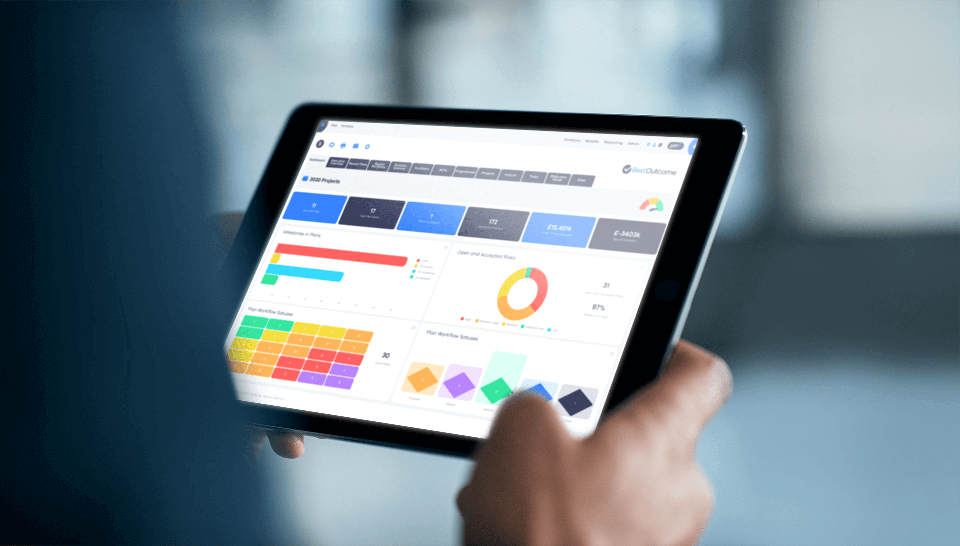
PM3 offers dashboards and more than 200 out-of-the-box reports, all designed to give teams a clean, honest view of what’s happening. It’s the kind of visibility that helps people prepare for audits, spot bottlenecks early, and communicate with regulators or leadership without scrambling.
Pharma projects often involve long timelines, strict controls, and a lot of stakeholders. PM3 keeps the attention on what truly matters — delivering the organisation’s strategic goals — rather than drowning teams in to-do lists. That outcome-first philosophy supports better alignment and more thoughtful decision-making.
One of PM3’s strengths is that it only shows people what they actually need. That simplicity reduces training time and makes adoption easier for busy teams. In environments where work is already complex, a tool that removes cognitive load instead of adding to it is a genuine advantage.
Whether teams use agile, waterfall, or a hybrid approach, PM3 adapts to them — not the other way around. This flexibility is valuable in pharma organisations where different projects follow different rhythms, from operational changes to longer regulatory programmes.
PM3 addresses several common challenges pharma teams face:
These are everyday friction points in regulated environments — and PM3 is built to reduce them.
PM3 comes with expert training and mentoring from experienced PPM specialists. It’s not just a tool handed over on day one; it’s ongoing guidance from people who understand how to help teams succeed.
Pharma teams don’t have the time (or patience) for long, consultant-heavy setups. PM3 can be configured quickly to match existing processes, making it easier for organisations to get value without a disruptive rollout.
In short, PM3 gives teams the clarity, structure, and focus they need to manage complex work — without overwhelming them. And in a pharmaceutical environment, that kind of support can make regulatory projects feel far more manageable and far less stressful.
PPM tools for pharmaceutical compliance make it easier to trace decisions, show why actions were taken, and explain how changes were handled. Those are small wins on paper, but for people preparing for inspections or responding to questions, they’re the difference between feeling rushed and feeling prepared.
In the end, compliance is still about people doing careful work under real pressure. Tools won’t replace that effort, but they can make the path a little clearer — and that clarity is often what helps teams deliver the safe, reliable medicines they’re trusted to bring forward.
Image Source: Astrid.IQ

Our products help you deliver successful change programmes and projects by always focusing on the overall business outcomes. Find out how our products can help you.
Discover PM3 Schedule a Demo