While agile has been stealing the project management methodology spotlight in recent years, let’s not forget another approach that has truly stood the test of time – the waterfall methodology.
With its structured and sequential nature, the waterfall process brings a level of clarity to project management, offering a multitude of benefits for all stakeholders.
It can make your projects flow smoothly, avoid bottlenecks, help you hit deadlines, ensure deliverables are met before the next phase begins, and allow the team overall to shine with perfection.
This in-depth guide analyses the advantages of the waterfall methodology. Learn the benefits and understand the edge over agile in this PMO expert assessment.
The waterfall method of project delivery has, in recent years, developed something of a poor reputation, with many organisations proudly declaring that they have “gone agile”.
For some professionals, agile has become synonymous with being nimble, flexible and adaptive — all highly desirable qualities in any methodology. By contrast, anything that is not labelled agile is often assumed to be rigid, slow or inflexible.
At face value, the choice may seem obvious.
However, this view is overly simplistic. Both waterfall and agile approaches have their merits, yet in some organisations the debate has become polarised, as though only one can be valid.
In reality, such thinking is misplaced. As we will explore, both approaches can be entirely appropriate depending on the context.
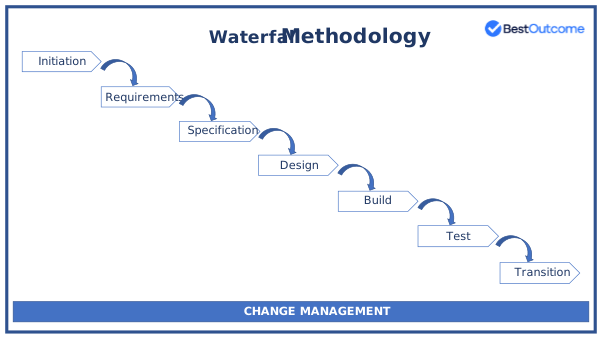
The waterfall model, or waterfall methodology, takes its name from the way a project progresses through clearly defined, sequential stages. Unlike iterative approaches, the waterfall methodology requires each phase to be fully completed before the next begins.
A typical waterfall methodology project starts with initiation, where the project’s objectives, scope, costs and anticipated project benefits are defined, and the team is mobilised. It then moves into the requirements phase, during which business or user requirements are gathered, documented and formally signed off.
Once agreed, these requirements are elaborated in greater detail. The waterfall methodology then progresses through technical design, build and testing before ultimately transitioning into live service.
The structured nature of the waterfall methodology provides clear checkpoints and governance at each stage of delivery.
A common criticism of the waterfall methodology is that user involvement is concentrated in the early phases — particularly during requirements gathering and specification — with limited engagement until user acceptance testing. During this period, it is argued, requirements may evolve or misunderstandings may go unnoticed.
The reasoning follows that in fast-changing business environments, requirements are likely to shift. If users are not engaged throughout the lifecycle of a waterfall methodology project, these changes may not be communicated effectively to the project management team.
As a result, a project delivered using the waterfall methodology may meet the original specification but fail to reflect current business needs.
However, this outcome is not inevitable in a well-managed waterfall methodology project.
An effective project manager using the waterfall methodology remains focused on delivering outcomes that genuinely meet user needs. Ongoing communication between the project team and the user community should not cease after requirements sign-off.
Sensible governance and active stakeholder engagement can ensure alignment is maintained throughout the waterfall methodology lifecycle.
One practical tool that supports this ongoing alignment in a waterfall methodology project is the use of a decision log.
A structured decision log captures key project decisions, the rationale behind them, the stakeholders involved and any agreed actions, often providing valuable visibility to the project steering committee. By formally documenting changes, clarifications and assumptions, the project team creates transparency and accountability throughout the lifecycle.
This not only reduces the risk of misunderstandings but also provides an auditable trail that strengthens governance — particularly in complex or regulated environments where control and traceability matter, such as projects in the healthcare sector.
This emphasis on documentation and structured control is, in fact, one of the strengths of the waterfall methodology.
In many projects, requirements are stable and unlikely to change significantly. In these circumstances, investing time in defining and documenting requirements to a high level of detail creates clarity and certainty around what must be delivered.
For some teams, this structured and sequential project management approach increases confidence, improves predictability and enables more efficient control of delivery.

Discover practical strategies for improving oversight and audit readiness.
Winston W. Royce was an American computer scientist and software engineer who made significant contributions to the field of software development and project management.
He is best known for his paper titled “Managing the Development of Large Software Systems,” published in 1970, which introduced the concept of the waterfall model.
Different projects require different approaches, and there are a number of situations when the waterfall approach is ideal.
These include:
The agile methodology has a very different approach to waterfall. There is more emphasis on flexibility and speed of delivery.
With a real focus on delivering modules or part of a project quickly, there are numerous approaches when it comes to agile project management.
A common method involves developing user stories which are a set of mini requirements or features of a system.
These user stories are developed in close conjunction with the key users.
As we will see later, the agile philosophy is to work very closely with the users and the product owner.
These user stories will have broad estimates and are then placed in what is called a sprint.
These sprints are typically time bound and during the sprint some stories may be demoted from the sprint and not delivered as there is typically a fixed sprint delivery date.
There are a lot of feedback loops in agile and it delivers software in a set of iterations, unlike waterfall which tends to be more sequential and often results in a ‘big delivery’.
The original team of professionals who developed agile as a method, developed a number of agile principles.

Learn how to apply rolling wave planning to keep projects on track.
Source: Agile manifesto
These are a great set of principles, but they also rely on certain organisational factors being in place.
For example, there is more emphasis on self-organising teams than in waterfall, and a level of trust is needed to get the job done.
There is also a requirement for team members to be collaborative and the users to be part of the team. Ideally, the team is located in the same place as this makes collaboration and self-organising easier. Yes, a lot of teams are now working from home and using Teams or Zoom, but this is not as efficient as collaborating in the same place.

Explore the fundamental differences between OKRs and KPIs and how they can work together to drive business outcomes.
There are several situations when an agile approach is suitable.
These include:
There are many benefits of agile, including:

Learn more about selecting the right project portfolio management tool for your organisation
IT teams are often searching for the “silver bullet” that will deliver projects faster and more successfully. Yet overall project success rates have not significantly improved.
In our view, agile is an excellent approach for certain types of projects, but it can also introduce a more complex set of processes to manage. Agile teams must be adaptable and capable of absorbing frequent change. Not every team is equipped to operate effectively in this way, and not every project is suited to an agile approach.
Nevertheless, many organisations have simply “gone agile” across the board. Before discarding the so-called “old-fashioned” waterfall methodology, it is important to assess whether the project and the team are genuinely suited to agile delivery — or whether the waterfall methodology may in fact provide greater structure, clarity and control.
The waterfall methodology has undoubtedly suffered from poor press over the years, and those who continue to use it are sometimes unfairly labelled as outdated.
The reality, however, is that some projects are ideally suited to the waterfall methodology. Project success rates improve when organisations choose between agile and the waterfall methodology based on context rather than trend, ensuring each initiative aligns with the wider business portfolio and strategic priorities.
So, in the spirit of these agile times, remain flexible.
Waterfall software refers to the application of the waterfall methodology in software development projects.
The waterfall methodology is a linear and sequential approach to project management that was initially introduced in the manufacturing and construction industries but has since been adapted for software development.
In the context of development methodology, the waterfall model follows a sequence of different phases, with each new phase depending on the completion of the previous one.
The typical workflow includes requirements gathering, system design, implementation, testing, deployment and maintenance.
Once a phase is completed, the project moves forward, and it becomes a challenge to revisit and make changes to the previous phase without disrupting the entire process.
The waterfall approach is often characterised by its well-defined documentation, comprehensive planning and clear milestones.
It emphasises thorough upfront planning and a detailed understanding of project requirements before proceeding to the development stage.
This methodology assumes that the project requirements can be clearly defined at the beginning and remain relatively stable throughout the project’s lifecycle.
As a project management approach it has many benefits, such as providing a structured framework and facilitating documentation.
However, some project managers will always argue that it lacks the flexibility and adaptability to changes that can arise during the software development process.
Agile methodologies, which prioritise iterative and collaborative approaches, have certainly gained popularity as alternatives, particularly in dynamic and complex software engineering projects.
It’s important to note that the waterfall methodology assumes a linear progression through these stages, with each stage being completed before moving on to the next. This sequential nature distinguishes the waterfall model from more iterative and flexible methodologies like agile.
The waterfall methodology and agile methodology differ significantly in their approach to project management and software development. Here are some key differences between the two:
Both methodologies have their strengths and weaknesses, and their suitability depends on the specific project’s nature, requirements and constraints. Waterfall is typically used in projects with well-defined and stable requirements, while agile is favoured in projects that require flexibility, adaptability and frequent customer involvement.
The waterfall model is a traditional and sequential approach used in the Software Development Life Cycle (SDLC). It follows a linear progression of phases, where each phase is completed before moving on to the next. The waterfall model typically consists of the following phases:
The waterfall model assumes that project requirements can be clearly defined upfront and remain relatively stable throughout the project. It is characterised by its emphasis on comprehensive planning, documentation and a well-defined sequence of phases. However, the waterfall model can be less adaptable to changes and may not accommodate feedback and adjustments as effectively as more iterative approaches like agile methodologies.
No, the waterfall method does not use scrum. Scrum is a specific agile framework, whereas the waterfall method is a traditional and sequential approach to project management.
Scrum focuses on iterative and incremental development, emphasising flexibility, collaboration and adaptability to changing requirements. It utilises short development cycles called sprints, daily stand-up meetings and various scrum artefacts (such as the product backlog and sprint backlog) to manage projects.
On the other hand, the waterfall method follows a linear and sequential approach, where each phase is completed before moving on to the next. It emphasises comprehensive upfront planning and assumes that project requirements can be defined and remain stable throughout the project.
While scrum and the waterfall methodology are both project management approaches, they have different principles, methodologies and practices. Scrum is designed to accommodate changing requirements and encourage collaboration, while the waterfall method is more suitable for projects with well-defined and stable requirements.

PM3 is an award-winning PPM tool designed to manage everything from strategic portfolios to day-to-day projects without unnecessary complexity. With intuitive dashboards, configurable reporting and over 200 out-of-the-box reports, PM3 provides the visibility organisations need to make informed decisions and maintain control across waterfall, agile or hybrid environments.
PM3 is built around an outcome-first philosophy, helping teams stay aligned to strategic goals rather than simply tracking tasks. With capabilities that support prioritisation, portfolio alignment and benefits realisation, PM3 ensures that projects are not only delivered efficiently, but also contribute measurable value to the organisation.
Unlike rigid or overly complex systems, PM3 adapts to your processes — not the other way around. With fast, configurable implementation and expert training and mentoring from PPM specialists, PM3 helps organisations strengthen governance, improve resource management and enhance collaboration without lengthy rollouts or disruptive change.

Our products help you deliver successful change programmes and projects by always focusing on the overall business outcomes. Find out how our products can help you.
Get in Touch Schedule a DemoThe latest release of PM3 includes a number of important functional improvements including:...
Read more >We at Bestoutcome were working recently at an oil company where there was a desire to improve the su...
Read more >